


The Persistent Widow

Updated: Jan 11
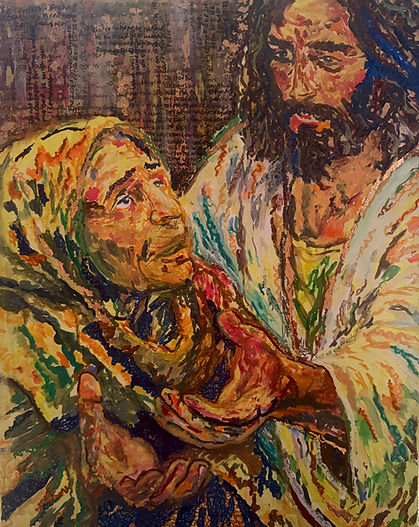
The Persistent Widow
Painting by: Vashti Graham
Copper gold leaf, writing art background, and artistic touch by: Felicia Lee
Artist Description:
In the parable of Luke 18: 1-7, Jesus tells the story of a widow who continually pleads with an unjust judge to grant her justice. Though the judge doesn’t fear God or care about people, he finally grants her request. He did this not out of compassion, but because her persistence wears him down. Jesus uses this story to teach that prayer isn’t about pestering God into giving us what we want; it’s about building faith through persistence. The widow’s perseverance reflects trust, not manipulation. She keeps coming because she believes justice is possible. In the same way, God invites us to come to Him continually, not to change His heart, but to show that we depend on Him fully. Persistent prayer transforms us, deepening our faith and aligning our hearts with God’s will.
Scripture References:
Luke 18:1-7 Then Jesus told his disciples a parable to show them that they should always pray and not give up. He said "In a certain town there was a judge who neither feared God nor cared what people thought. And there was a widow in that town who kept coming to him with a plea "Grant me justice against my adversary". For some time he refused. But finally he said to himself, “Even though I don’t fear God or care what people think, yet because this widow keeps bothering me, I will see that she gets justice, so that she won’t eventually come and attack me!” And the Lord said, “Listen to what the unjust judge says. And will not God bring about justice for his chosen ones, who cry out to him day and night? Will he keep putting them off?”
Additional Facts You May Find Interesting:
Luke 18:1–7 is one of those passages that hits especially hard when you’re tired, discouraged, or waiting on God for something that feels unfair (which is exactly why Jesus told it).
This parable is literally introduced with the purpose: “Jesus told them a parable to show them that they should always pray and not give up.” (Luke 18:1) That’s rare in Scripture. Jesus doesn’t usually explain the moral before the story, but here He does. The whole point is don’t quit praying just because you don’t see results yet.
The widow in this story had: 1. no husband 2. no money 3. no legal power 4. no social standing. (In that culture, she was completely invisible. Yet she keeps showing up. That’s the heart of the parable: God honors faith that refuses to disappear.)
The judge is intentionally described as: 1. not fearing God 2. not caring about people.
Jesus is making a comparison by contrast. If even a corrupt, selfish judge will respond to persistence, how much more will a loving, just God respond to His children?
So this story is not saying God is annoyed by us. It’s saying: If persistence moves an unjust man, imagine how much more it moves a righteous Father.
Delays are not denials. Silence is not abandonment. Repetition is not lack of faith; it is proof of it.
Jesus likely told this story in Aramaic. Aramaic was the everyday language of Jewish people in Galilee and Judea in the first century. We know this from Scripture because some of Jesus’s actual Aramaic words are recorded for us. Some examples are: 1.“Talitha koum” (Mark 5:41) “Little girl, get up.”, 2. “Eloi, Eloi, lama sabachthani” (Mark 15:34) “My God, My God, why have You forsaken Me?”, and 3. “Abba” (Mark 14:36) “Father.” These are Aramaic, not Hebrew. Jesus also knew Hebrew, which was the language of Scripture. When He read from the scroll in the synagogue (Luke 4:16–21), He was reading Hebrew, and when He quoted the Old Testament, He was quoting Hebrew Scripture. Jesus also likely understood and spoke some Greek as well. Greek was the common language of the Roman Empire and was used in business, government, and daily communication across cultures. Galilee, where Jesus grew up, was surrounded by Greek speaking cities and Jesus regularly interacted with Gentiles, Roman officials, and foreigners (Matthew 8; John 4; Mark 7), which would have required Greek.
In the first century:
Hebrew was the language of Scripture, prayer, and synagogue worship
Aramaic was the spoken, everyday language of Jewish people in Judea and Galilee
This is why: 1. Jesus read from the scroll in Hebrew (Luke 4:16–21) 2. But His spoken words that are preserved (Talitha koum, Abba, etc.) are in Aramaic. Jesus likely knew Hebrew and used it for Scripture, but He spoke Aramaic when He talked to people. This situation is also confirmed by archaeology: Many Jewish documents from the time (letters, contracts, etc) are written in Aramaic and Hebrew appears mostly in religious texts.
Yet because this widow keeps bothering me, I will give her justice, so that she will not wear me out by her continual coming.” (The phrase “wear me out” is where hypōpiazō appears.) In Greek, Luke 18:5 says: “hina mē eis telos erchomenē hypōpiazē me”
Which means: “so that by her continual coming she will not hypōpiazō me.” When our English Bibles say: “wear me out”, “bother me”, “attack me"....behind those words is the Greek hypōpiazō (a word that means to be beaten down by repeated blows).
All of this language study shows that Luke likely wrote this parable in Greek (all early manuscripts of Luke are in Koine Greek) and used the word hypōpiazō (ὑπωπιάζω). That word literally means “to strike under the eye” or “to beat down.” It comes from the world of fighting and describes being worn down by repeated hits rather than one big punch. Luke uses a word that expresses the force of what Jesus was teaching; the widow is obviously not physically punching the judge (she’s just emotionally drop kicking his patience until he gives up). This is a visual metaphor. Think of boxing: a fighter does not usually win with one massive knockout. Most of the time it happens through small, repeated strikes, over and over, until the opponent can no longer resist. That is exactly what the widow is doing. She keeps showing up. She keeps asking. She keeps knocking.
Every time she comes back, it is another small blow against the judge’s resistance. Eventually he gives in, not because he is good, but because she is persistent. Jesus is showing us what prayer looks like. (Not one perfect prayer. Not one emotional moment.) But returning again and again and saying, “I still trust You, God.” Jesus likely told this story in Aramaic, the everyday language He spoke. Luke wrote it in Greek so more people could read it. The Greek word hypōpiazō matches the strength and meaning of what Jesus was teaching. That is how the Bible works; the message stays the same even when the language changes. Jesus was teaching something powerful: Faith does not knock once. Faith keeps knocking.
“Ask, and it will be given to you; seek, and you will find; knock, and it will be opened to you.” (Luke 11:9)
Collaborator Reflection:
“My intention with the layered scripture and the use of gold leaf is to reflect how, at times, we do not see or feel God when we expect to. Yet His grace is always present. The scripture is written into the surface, partially obscured, much like prayer that continues even when answers feel delayed.
The gold leaf reveals itself only when the light shifts, requiring a pause, a tilt, or a change in perspective. In the same way, God’s presence often becomes clearer when we alter how we approach His Word and His guidance.
Sometimes it is not that He is absent. Sometimes it simply takes patience, persistence, and a willingness to see differently.” -Felicia Lee


